 Cardamoo
What are blinds in poker?
Blinds are the two forced bets that start every hand of Texas Hold'em. They're small, they're mandatory, and they're the reason poker works at all.
The small blind and the big blind
Before any cards are dealt, the player directly left of the dealer button posts the small blind, and the player after them posts the big blind, usually double the small. "Posting" just means putting the chips in before you've seen a single card. That's where the name comes from: you're betting blind.
Why blinds exist
Imagine poker without them. Sitting out costs nothing, so the safest play is to fold every hand until you're dealt aces, and if everyone does that, there's no game. Blinds fix this with one elegant rule: there's already something in the pot, and it came out of somebody's stack. Now every hand has stakes. The blinds want to defend the chips they were forced to commit, and everyone else has a pot worth attacking.
How the blinds move
The dealer button moves one seat clockwise after every hand, and the blinds move with it. Over a full orbit of the table, every player posts each blind exactly once, the cost of playing is shared perfectly evenly. Nobody escapes it, nobody pays extra.
What the big blind means for you pre-flop
The big blind is the price of entry for the hand: to play, you must at least call it. There's one nice perk of posting it, if nobody raises before the action gets back to you, you can check and see the flop without paying anything more. You already paid, after all.
Blinds are how stakes get named
When a table is described by two numbers, like 1K/2K in Cardamoo, that's the small blind and big blind. Those two numbers scale everything: the size of a normal raise, the size of the pots, and how much you should sit down with. Bigger blinds, bigger game. It's also why players measure stacks in big blinds rather than raw chips, "fifty big blinds" describes your room to play at any table, at any stakes.
Blinds in tournaments
In a tournament, the blinds rise on a schedule. What starts as pocket change becomes a real threat to your stack, which is exactly the point: rising blinds force action and guarantee the tournament actually ends. If you fold long enough, the blinds alone will eat your stack, waiting forever is not a strategy.
Feel it at the table
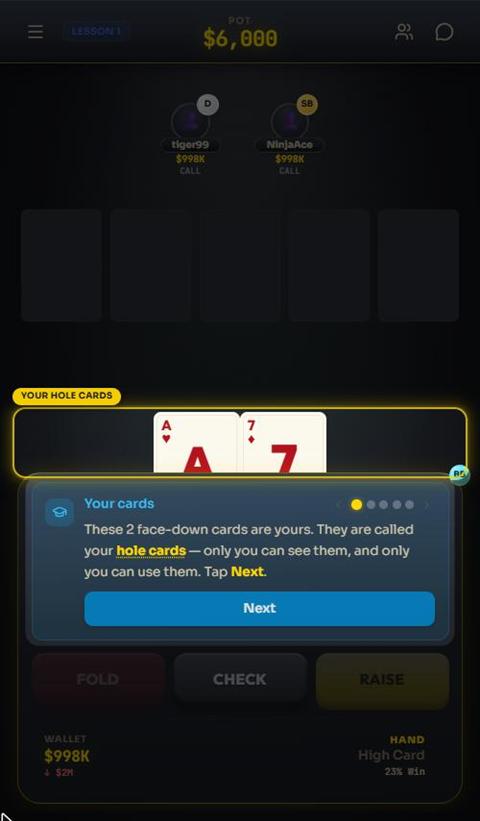
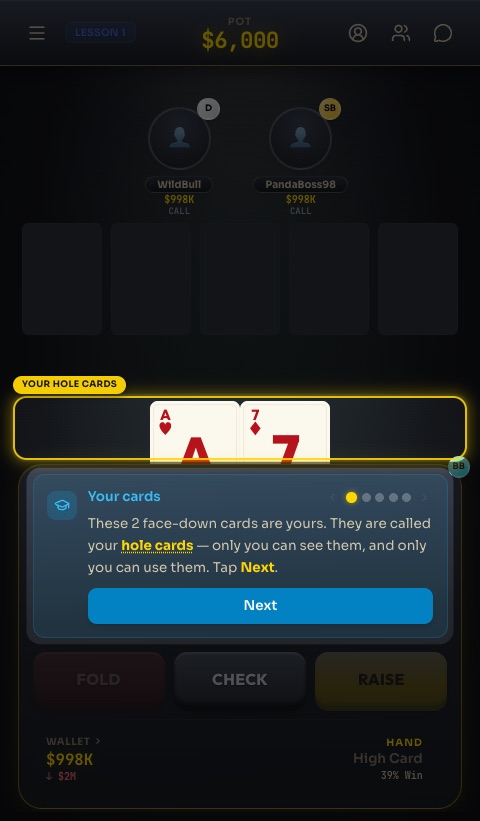
One orbit of posting blinds teaches this better than any article. Cardamoo's guided lessons put you in the seats, walk you through the flow, and let the rhythm of the button do the teaching.
Start the lessons, free in your browserNo account needed to try · a free account saves your progress across devices
Next: The five actions · Position in poker · Back to: How to play