 Cardamoo
Check, call, bet, raise or fold
Poker has exactly five moves. Every decision you will ever make at a Texas Hold'em table is one of them, so it's worth knowing precisely what each one means, and when it's even on the menu.
The five actions
Check, pass your turn without putting in chips. You keep your cards and stay in the hand, but you're only allowed to check when nobody has bet in the current round. Think of it as saying "no bet from me, next player."
Bet, put chips into the pot when nobody else has this round. The moment you bet, everyone still in the hand has to at least match your amount to continue. You've set the price.
Call, match the chips someone else has bet, so you stay in the hand. No more, no less. Calling says "I'll pay that price to keep playing."
Raise, match the current bet and add more on top. Now everyone, including the original bettor, has to match your new, bigger amount to stay in. A raise turns the pressure right back around.
Fold, give up the hand. Your cards go away, and you're out until the next deal. You lose the chips you already put in this hand, but not a single chip more.
Why you never see all five at once
The buttons in front of you depend on one question: has anyone bet in this round yet?
- Nobody has bet, you can check (free) or bet (set a price). Folding here is technically allowed but pointless: checking keeps your cards for free.
- Someone has bet, you can call (pay the price), raise (raise the price), or fold (decline to pay). Checking is off the table: there's a bet in front of you, and you can't just wave it through.
That's the whole system. Each betting round continues until everyone still in the hand has put in the same amount, or folded rather than pay it.
All-in: the fifth-and-a-half action
Going all-in just means betting, calling or raising with every chip you have. It isn't a separate move, it's one of the moves above, taken to its limit. Once you're all-in you can't be forced out of the hand, but you also can't win more from each opponent than you were able to put in yourself.
The mix-ups that cost beginners chips
Calling when you could check
If nobody has bet, there is nothing to match, so "calling" is just a free pass wearing a costume. Some apps disable the call button in this spot; in real life, tapping the table means check. Either way: when it's free, check. Save the word "call" for when there's actually a price.
Confusing a bet with a raise
They feel similar, chips go in, but a bet opens the action in a round, and a raise answers a bet that's already there. The distinction matters because a raise says something louder: someone set a price, and you said "not enough."
Folding a free hand
Never fold when you could check. It sounds obvious written down, and it happens at real tables constantly, a player with a weak hand gives up even though seeing the next card would have cost nothing. If the price is zero, pay it. The next card might be yours. (More on this in draws and outs.)
What the actions say about a hand
Once the mechanics are automatic, the actions become a language. A check often whispers "nothing much here." A bet claims strength. A raise claims more. None of these claims has to be true, that's what bluffing is, but every action tells a story, and players who listen win more pots. Start with what bet sizes mean when you're ready for that layer.
Try all five in one hand
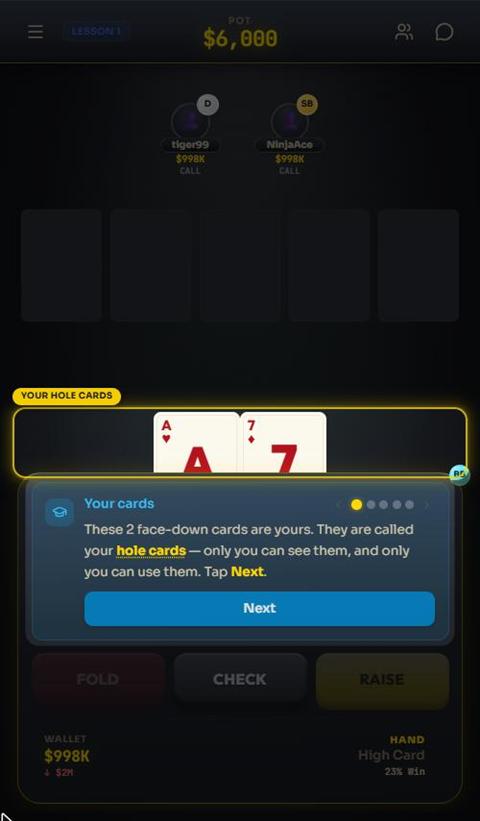
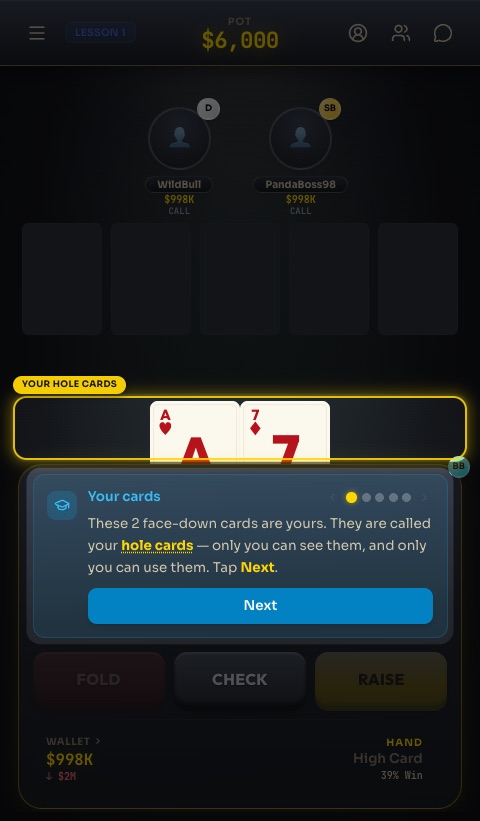
Reading about buttons is one thing; pressing them is another. Cardamoo's second guided lesson deals you a real hand and has you check, call, bet, raise and fold, each at the moment it actually makes sense.
Start the lessons, free in your browserNo account needed to try · a free account saves your progress across devices
Next: Position in poker · When to fold