 Cardamoo
Position in poker: why acting last wins
Ask a strong player what beginners underestimate most and you'll hear the same answer again and again: position. Where you sit relative to the dealer button quietly changes the value of every hand you're dealt.
What "position" actually means
Position is simply where you act in the turn order, and turn order in Texas Hold'em is fixed by the dealer button. After the flop, the player on the button always acts last in every betting round, and the players in the blinds act first. Since the button moves one seat clockwise each hand (see how blinds rotate), everyone cycles through every position over an orbit.
"Having position" on someone means you act after them. It sounds like a small scheduling detail. It's one of the biggest edges in the game.
Acting last means deciding with more information
Poker is a game of incomplete information, you can't see anyone's hole cards. But you can see what people do, and every check, bet and fold leaks something. When you're last to act, everyone else has already leaked before your turn.
Imagine holding a middling hand on the flop. Acting first, you're guessing: bet into the unknown, or check and hope? Acting last, the guessing is done for you, if the whole table checked around, they've told you nobody is proud of their hand, and even a modest bet might take the pot. Same cards, entirely different decision quality.
Acting early is playing blindfolded
Flip it around. In the big blind, you act almost first after the flop. Three players are still to speak behind you, and every choice you make gets answered by people who watched you make it. Bet, and someone with a real hand raises you. Check, and you've invited everyone to take a stab at the pot. Playing out of position is like negotiating while showing your notes.
That's why the standard advice isn't "never play early", it's play carefully when you act early: fewer hands, stronger hands, fewer fancy moves.
The button is the best seat in the game
The dealer button gets the last word in every betting round after the flop. That single fact means:
- Free cards when you want them. Everyone checked to you? You may check right behind them and see the next card for nothing.
- Cheap steals when they're weak. A table full of checks is a table full of shrugs, a bet from the button wins more than its fair share of small pots.
- Better value from strong hands. You've seen everyone's action before deciding how much to charge them. (More on that in bet sizing.)
This is why experienced players play noticeably more hands from the button than from any other seat, the seat itself is doing some of the winning.
How position should change your play
You don't need charts to use position well. Two habits capture most of the value:
- Widen late, tighten early. A hand that's a comfortable play on the button can be a clean fold in early position, not because the cards changed, but because the information changed.
- Respect bets from early position. Someone who bets knowing four players act behind them usually isn't joking. The same bet from the button could easily be a stab at an unwanted pot.
It evens out, that's the design
The button and the blinds move every hand, so over a full orbit everyone gets the good seat and everyone pays the forced bets exactly once. Position isn't unfair; it's a rhythm. The players who win are simply the ones who notice which beat they're on.
Feel both seats yourself
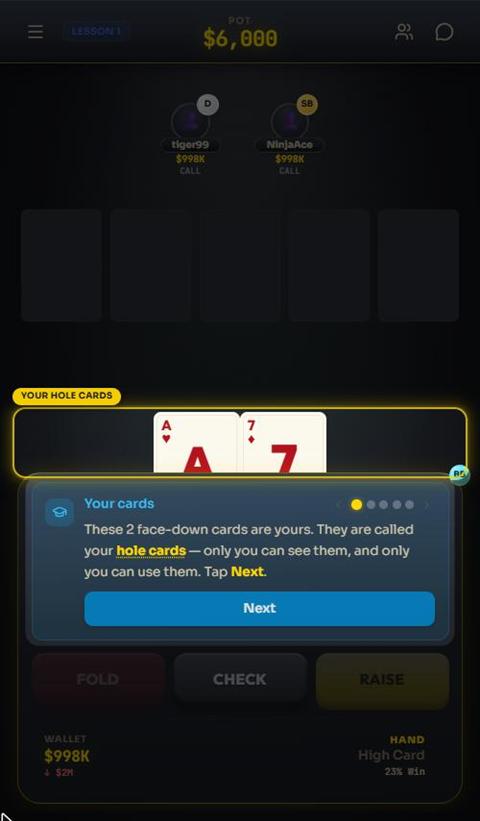
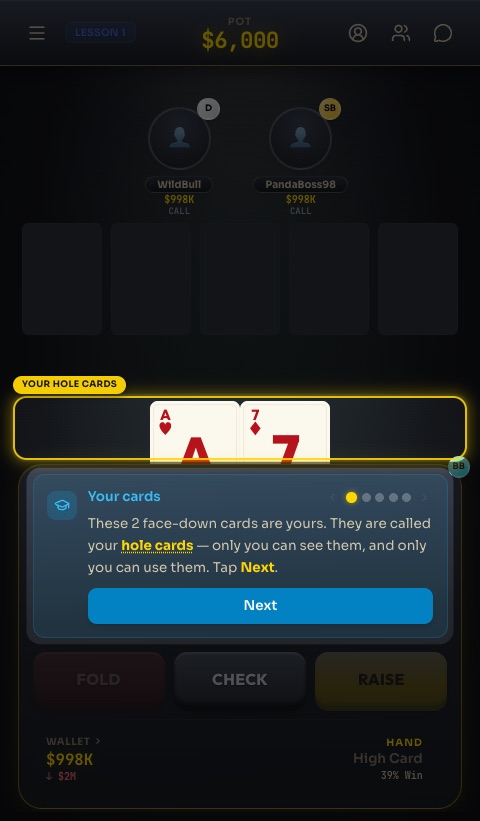
Cardamoo's position lesson deals you one hand from the dealer button and one from the big blind, same table, opposite experience. Ten minutes in those two seats teaches what a chapter of theory can't.
Start the lessons, free in your browserNo account needed to try · a free account saves your progress across devices
Next: When to fold · Back to: What are blinds?